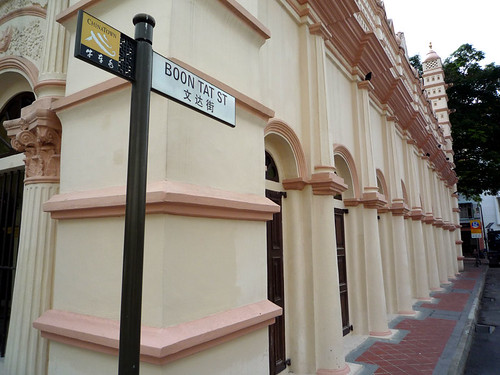
Famous Old Places of Singapore (That Still Exist Today)
I saw an old 1930s movie about Singapore, entitled "Singapore: Crossroads of the East" at yesterday.sg.
Described by a 22 September 1956 issue of Boxoffice (a trade magazine dedicated to the film industry at that time) as "an economic look at Singapore, its harbour, rivers, natives and other peoples", I found some famous old places of Singapore featured in the 1938 film rather familiar.
YouTube (below): This film is available for download. You can also embed it in your blog by clicking on the right lower corner of the YouTube movie below.
For old places and buildings to remain standing after 71 years and more, despite the constant makeover of our little island, they richly deserve publicity and fame.
What impressed me about this film were the many famous old places of Singapore shown in the film that are still standing today. As a comparison, how many of you live in properties that are older than 71 years?
To travel back in time to see those old places in the 1930s was an out-of-this-world experience. Better than photographs, the film breathed a surreal sense of life into those famous old places.
The surrounding neighbourhoods around those buildings and famous old places in Singapore may have changed beyond recognition, but the buildings and famous old places have kept their shapes mostly unchanged.
Do you recognize those famous old places in Singapore that were shown in the film? I could discern Chinatown's Thian Hock Keng Temple, Sri Mariamman Temple and Sultan Mosque. The Singapore River scene with Cavenagh Bridge and Elgin Bridge, plus the famous rows of godowns would be familiar to most of you. How about the Cenotaph, Victoria Memorial Hall, City Hall, St Andrew's cathedral near Queen Elizabeth Walk (now Esplanade Park)?
Besides the buildings and places, I found the mode of transportation in those days to be fascinating too. In one scene (3:45), did you notice the poor guy using 'car' (leg) power to pull his rickshaw that was loaded with four occupants? How about the bullock carts, horse-drawn carriages and bumboats? No traffic lights in 1938? No problem, call the mobile traffic light warden with the huge sign across his back and white gloves to direct traffic flow.
Guys who have done or are doing National Service duties may be interested to know how a regular in 1938 wore his uniform, helmet, rifle and SBO. Those in the Airforce, would likely blink twice to see the state-of-the-art flying machines performing airforce duties.
You do not need to be a heritage enthusiast to watch this old film of famous places in Singapore. My kids were really thrilled to watch a slice of Singapore life that they never knew existed. You may even find some of those scenes a little comical.
While some of those famous places may be still be around today, do you think they will last forever?
For future generations to learn about our history and understand our roots, I hope they do.
I was intrigued to take a look at the last kampong place still standing in mainland Singapore. Blogspot friends like Lam Chun See and victorkoo mentioned it. There's even a TV programme about Singapore's Kampong Lorong Buangkok in Australia.
Being a busybody and someone who likes to visit offbeat places in Singapore, this Kampong place at Lorong Buangkok was on my list of must-see places in Singapore.
On a recent weekday afternoon, I became a voyeur just like many Singaporeans who visited Kampong Lorong Buangkok upon hearing that this piece of authentic kampong heritage might be gone forever.
Before the trip to this Kampong Lorong Buangkok place, I received briefing through the Internet. By learning from other visitors who had written about muddy tracks, pesky mosquitoes and fierce canine encounters, I ventured out on my solo journey of discovery with some trepidation.
Finding Kampong Lorong Buangkok, off Lorong Buangkok, was harder than I expected. Like an archaeologist with a map that had no cross to mark the spot, I wandered into the backlanes of Buangkok estate, in search of a Kampong place that did not exist in my copy of street directory.
Who would have thought that a kampong, being so uniquely different from the tall cookie-cutter HDB flats, could hide itself so well from civilisation? Lesson learnt: kampongs are low-rise residential places that camouflage themselves well in the woods.
With much backtracking, I drove up and down Gerard Drive and Lorong Buangkok until I spotted this Kampong Lorong Buangkok sign post.
Image: Welcome to Kampong Lorong Buangkok, the one-and-only Kampong place in mainland Singapore, with old trishaws and smouldering open fire.
So there I was, poking my nose inside other people's properties, wandering around the dirt track of Kampong Lorong Buangkok and wondering what kampong treasures or secrets I might uncover.
Was I looking for a lifestyle angle? Like looking at what Kampong residents kept in their backyards...
Image: This Kampong place had a well-worn chair that reflected the taste of a resident.
or in their front yards...
Image: Red roses add a touch of colour to this Kampong place.
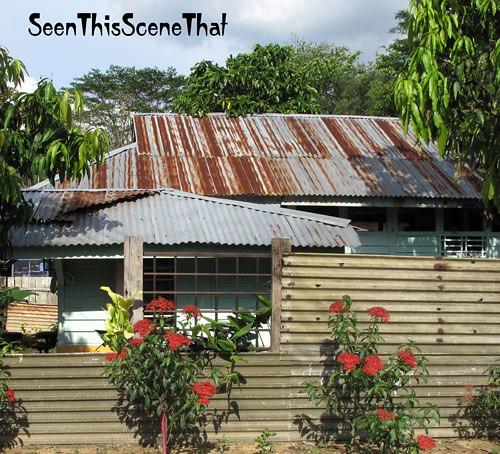
or around their yards... Images: Wall, fence and tyre in this Kampong place.
Was I looking for some human interest Kampong news? Like how did the residents feel about strangers walking up to their Kampong homes, snapping photographs of their Kampong properties as if there would be no more Kampong places left on the face of Singapore soon?
Or how did residents feel about the possibility of losing their heritage-endowed kampong homes and familiar Kampong places, to make way for non-Kampong progress and non-Kampong re-development soon?
What about this: How is life like, living in a kampong home? Auntie, uncle, do you have cisterns to flush your toilets? Is there clean running water, a water storage tank or a deep hole for a well?
Is your corrugated Kampong zinc roof rain-proof, heat-proof, sound-proof, mosquito-proof and harnesses sunlight like no other roof?
And by the way, do you get tired answering all these silly questions from inquisitive Singaporeans and nostalgic globe-trotters about your heritage Kampong living and back-to-nature lifestyle?
Hello, is anybody home?
Or are you also caught up in the modern rat race despite living in an ancient kampong place and won't come home so soon?
One last question please. Can I have your email address, so that you can answer my silly questions about Kampong places in Singapore when you're back in your kampong?
What makes the Nagore Durgha building a National Monument? Is its long history since 1830 a reason? Or is there another head turning reason? I chanced upon this building when I tried something new by exploring the places around Chinatown, instead of just doing the pre-Lunar New Year sightseeing and shopping ritual.
What is so unique about the Nagore Durgha to deserve the label of a National Monument? Nothing. I knew nothing about the Nagore Durgha when I first laid eyes on it. What has changed over the years? Nothing much. Until I checked out the National Heritage Board’s publication, “Singapore’s 100 Historic Places”.
Gazetted as a National Monument on 29 November 1974, Nagore Durgha was the building of religious and cultural importance for the Chulias, who originated from South India along the Coromandel Coast in the 1820s.
I was intrigued by this building (photo above) when I walked past 140, Telok Ayer Street recently. This detour was made before visiting Chinatown. I took photographs of parts of Nagore Durgha which attracted my interest even as I did not know much about it at that point in time.
Anything that still stands in Singapore since its construction in 1828 to 1830, must have a solid history as long as its existence. The owners must also be really passionate people who believe in what they have built, to protect their building against the elements and the changing landscapes.
I shall not bore you with details about its history today. Even the book that I have been reading is clear in its brevity. “The Chulias originally built Nagore Durgha not as a mosque but as a shrine ...”. You’ll have to dig up history books to find out why that was so as the book reveals little else. Perhaps someone knowledgeable can enlighten everyone on this point.
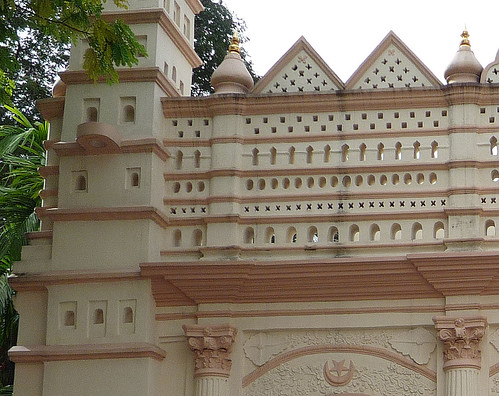
What I do wish to point out is the Nagore Durgha’s unique photogenic architecture. At eye level, its main frontage reveals a classical-styled facade. On top of this is an Islamic balustrade with two minarets.
The minarets taper upwards and end with onion-shaped domes. If you count the levels in each of the minaret, there should be 14.
[Photo shows minaret on the left third with level 6 to level 10 fully seen. The palace design is on the right upper two-thirds with the triangular-shaped tops.]
Levels 1 to 5 of the minaret are plainly designed. The 6th to 13th contain motifs and arched niches, while the topmost carries a checkered motif. To add more complexity to the design, there is a six-level facade of a palace.
When I first caught sight of the building facade, its impressiveness and uniqueness were undeniable. Little did I know, till I checked NHB’s little blue book, that except for some repairs, no major structural changes had been made since its construction. The same Nagore Durgha building I saw recently in 2009 had probably turned heads and impressed people since 1830.
Tourists who pass by Telok Ayer Street in Singapore should not miss the Telok Ayer Chinese Methodist Church.
Some reasons to spend a little time to explore this building:
1) Oldest Chinese-speaking Methodist church established in 1889.
2) Built in 1924-1925.
3) Gazetted as a National Monument on 23 March 1989.
4) Unique architecture of a western-style rectangular main body sitting on arched colonnades, with a pavilion roof shaped in the traditional Chinese manner.
5) Second-storey level church sanctuary.
6) Arches along its five-foot way look impressive.
Picture of Marina Barrage by the Marina Reservoir.
Marina Reservoir at Marina Barrage: Singapore's Newest City Reservoir
With the formation of Marina Barrage, Marina Bay has been turned into Marina Reservoir, Singapore's newest and youngest reservoir. The newly built Marina Barrage of Marina Reservoir has thus turned into the latest must-see attraction for Seen This Scene That.
To acquaint myself with this newest reservoir in the city, I brought my family of five for a visit to the hippest attraction in town at the Marina Barrage recently.
Located at 260, Marina Way in Marina South, the Marina Barrage is built on a far-flung patch of reclaimed land. To drive to Marina Barrage is not exactly a walk in the park, what with road diversions, land construction and high heavy-vehicle buzz along the roads. Fortunately, the property’s physical isolation meant fewer visitors to compete for free lots at the only car park on its premises. For those who do not drive, I believe there are shuttle buses at the car park waiting half-hourly to bring visitors from Marina Bay MRT Station.
Compared to older reservoirs like MacRitchie Reservoir or Upper Seletar Reservoir, I found this new Singapore dam and its reservoir different in many ways.
At ground level upon my arrival at the Marina Barrage, the obvious difference is the presence of massive concrete. There is little feel of a green vibrant park, although pockets of shrubbery exist. I would soon find out on exploring the area that the Marina Barrage takes after the form of our city, purpose-built to perfection.
One standout theme is the dedication and detail put into building the Marina Barrage in order to create the Marina Reservoir. To construct the Marina Barrage, plenty of engineering oomph was required because of the width and depth of the Marina Bay outlet. The Marina Barrage, with the Marina Bridge across it, is a highly sophisticated dam constructed across Marina Channel near the mouth of the Marina Bay. Complicated parts that work magic on this high-tech dam remain hidden in the bowels of an adjacent building.
According to PUB, the purpose-built Marina Barrage has three functions: for water supply, for flood control and as a lifestyle attraction.
The reservoir water in the Marina Basin is expected to turn into fresh water after a year or two. When that happens, more drinking water will be released for public use.
Marina Barrage prevents flooding as far upriver as Chinatown, Boat Quay and Geylang by regulating the water level in the Marina Reservoir with state-of-the-art technologies.
The recreational function of the Marina Barrage is of interest to me. In fact, it is the main reason I am at the 15th reservoir of Singapore. Most of the fun activities at the Marina Barrage occur outside the waters of the Marina Reservoir, unless you count the bumboat rides on the Marina Basin that are available for sight-seers keen to explore more of Marina Reservoir.
I think the obligatory recreational activity for all visitors to the Marina Barrage must be to walk along the 350-metre long dam (Marina Bridge) and then do a U-turn for the return stroll. I suggest you check out the east abutment where the boat hoist and access ramp are, especially when there are boats transported into or out of the Marina Basin.
The dam possesses nine tent-like shelters or piers that face the city skyline. Seats are available for romantic couples or families out for a picnic to gather under these pavilions to enjoy sunset views of our Central Business District. Just choose one and snap all the photos that your family album requires.
Picture of CBD night scene across the Marina Reservoir from the Marina Bridge.
The scenery around the 350-metre-long Marina Barrage has distinctive facades. On one side of the Marina Barrage, the view consists of built-up scenery of Singapore's commercial space like no other local reservoir. On the opposite side of the Marina Barrage, the open sea, dotted by ocean-going vessels, is laid bare. To top it off, 360-degree views of Marina South and beyond are afforded at the rooftop of the new Marina Barrage building.
Picture: Green rooftop of Marina Barrage.
Inside this Marina Barrage building, I found unique features not seen at other reservoirs in Singapore.
For instance, the Sustainable Singapore Gallery is a museum-like exhibition space with interactive multi-media tools that educate and engage visitors. The sloping green rooftop, with its 405 solar panels and weird geometric shape, is an excellent place at the Marina Barrage to breathe fresh air and enjoy city scenes. Large glass walls reveal the innards of the water pump station that should intrigue visitors who like to learn about the technical workings of the Marina Barrage. Food and beverage shop spaces were available but at the time of my visit, not all F&B establishments were ready for business.
While other reservoirs in Singapore have the standard-looking neighbourhood children’s playground, the Marina Barrage offers the newest children’s playground of a different kind. Jets of water spout from hidden holes on the floor of the Water Playground to delight happy children. Illuminated by colourful lighting, these water fountain displays provide entertainment for adults as well who visit the Marina Barrage in the evenings.
Although older reservoirs in Singapore have designated fishing spots, Marina Reservoir has none. Fishing enthusiasts will have to wait until Public Utilities Board (PUB) designates the proper sites for fishing (if any) at the Marina Reservoir. In the meantime, there is plenty of space for sea-water fishing along the banks of Marina South, just next to the car park at the Marina Barrage.
I hope that in the future, there will be guided nature walks around the Barrage for visitors curious to know if there are fauna and flora in a city reservoir. For now, the only guided tours are those conducted inside the Sustainable Singapore Gallery.
What I saw of the immediate surroundings beyond the Marina Barrage did not impress. Perhaps when the world-class Gardens By The Bay project is completed, the aesthetic factor of the its neighbours would rise above the concrete peaks achieved at Marina Barrage that created Singapore’s newest city reservoir.
Masjid Hajjah Fatimah is an old generation masjid (mosque) built from donation from a wealthy lady named Fatimah. Located at Beach Road next to Kampong Glam Park, Masjid Hajjah Fatimah was completed in 1846.
I was attracted to the mosque because of its architectural design. Walk around Masjid Hajjah Fatimah and you will notice the blend of local and European influence on its architecture. I later learnt that Masjid Hajjah Fatimah bore the imprint of a colonial architect by the name of J T Thomson.
Masjid Hajjah Fatimah is one of Singapore’s national monuments which had a leaning minaret that was righted during an extensive renovation work. It was gazetted on 6 July 1973 as a National Monument of Singapore, making it the first mosque to be listed as Singapore's National Monument.
The Masjid Hajjah Fatimah can accommodate up to 600 people. Religious lectures are conducted on its premises.
To get to Masjid Hajjah Fatimah, use the nearest MRT Station at Lavender (EW11).
[Wakaf is the dedication of properties by a Muslim through a will or otherwise for purposes recognised by Islamic law as pious, religious or charitable. Once this is done, the ownership is transferred to Allah (God).
The dedicator is called the wakif and the person he appoints to manage the properties to ensure that the purposes are carried out is called the mutawalli or trustee.
The income derived from these properties is used in accordance to the wakif's wishes for the benefit of the beneficiary.
Since 1968, under the Administration of Muslim Law Act (AMLA), these properties must be vested with MUIS. MUIS' role is to manage wakaf properties which have no trustees and to monitor other wakaf properties with trustees to ensure that the wakif's wishes are carried out.]
If you visit Kallang Riverside Park, you cannot miss two distinctive structures that bring memories to this area of Singapore. They are the blue steel pillars of what remains as the gas holder of Kallang Gas Works and an abstract sculpture called the Spirit of Kallang.
Kallang Gas Works Tall blue pillars are the gas holders that remain of Kallang Gas Works. These pillars that stand next to a carpark at Kallang Riverside Park are a reminder of the men and machines that gave life to street lighting in Singapore and cooking fires in homes of the past. Built in 1862, Kallang Gas Works was the town’s main supplier of gas that enabled streets to be lit after dark and helped residents to enjoy home-cooked hot meals in the comfort of their apartments.
The Gas Works, initially formed as the Singapore Gas Company was the predecessor to the Public Utilities Board which primarily supplied utilities to the Singapore public. The Singapore Gas Company was formed in 1861 to provide gas lighting for the Town. This company built the Kallang Gas Works in 1862 (at the location of Kallang Riverside Park) to supply the first piped gas in Singapore to enable street lighting. It was given the Hokkien nickname huay sia or "fire city" because of superstitious fears that it might just blow up.
Four tanks were built in total and operated in the Kallang Gas Works. Nos. 1 and 2 tanks were built with the original plant in 1862 and were in use until they were demolished in 1957. No.3 tank was built before 1900 whilst No. 4 tank was built between 1908 to 1909.
As electricity took over street lighting in 1906, the use of town gas for street lighting declined until the last gas lamp in 1956.
Modern Kallang Gas Works On 1 May 1963, the Public Utilities Board was constituted, taking over the responsibilities of the former City Council, for gas, electricity and water supply. Plans to develop the Riverwalk Park along Kallang Basin led to announcements in January 1987 that the Kallang Gas Works would be removed.
In July 1997, piped gas production operation was relocated to the S$240 million Senoko Gasworks. Singapore Power also opened a S$30 million gasholder at Toh Tuck at end March 1998 which serves as a contingency store of between 6 to 8 hrs gas supply should the Senoko operation face problems.Gas production continued uninterruptedly for 137 years at the Kallang Gasworks except for short breaks during the world wars. It opened to the public for the first time on 26 March 1998 before it would finally be demolished.
Present Time At Kallang Riverside Park Nowadays, the remaining pillars of the Kallang Gas Works stick out like ancient monoliths as if plucked from a by-gone era and transplanted into the greenery of Kallang Riverside Park. If you do not notice the information boards placed at the foot of this structure, you might have thought that some contractor went bust and could not afford to put a roof over this tent-like scaffolding in the middle of Kallang Riverside Park.
Spirit of Kallang sculpture at Kallang Riverside Park
Spirit of Kallang Sculpture A short stroll away along the Kallang Riverside, the Spirit of Kallang stands tall in this park. Its inscription about the Kallang Gasworks (1861 – 1998) reads:
“The Spirit of Kallang incorporates materials from Kallang Gasworks. Its design symbolizes the hardworking ethos and enduring spirit of the early pioneers of Singapore who worked hard to establish a better life for future generations.” The sculpture was commissioned by Singapore Power Ltd and created by Mr Lim Leong Seng.
If you walk around the Kallang Riverside Park on a late afternoon visit, gatherings of workers and friends who come from the surrounding suburb for an afternoon of picnics, leisure and siesta, can be seen. Elsewhere on the beaches of Kallang River, groups of water sports participants busy themselves at the park for an afternoon of recreational fun. Occasionally, you may witness dragon boats plying along the Kallang River while water skis jet about the river to compete for your attention.
Read about history in Singapore Parks in Seen This Scene That:
Where to go in Singapore to find these buildings with big heads and tiny bottoms? Are there aliens spinning tops somewhere out there in the green fields of Singapore? What are these twin structures?
If you have been following my postings closely, you will realize that I have a soft spot for towers. In my past post on the Upper Seletar Reservoir look out tower, I fell asleep under the spell of such a tower. Even the towers of Sentosa's Palawan beach have given me a wonderful feeling, besides the majestic views afforded from a position of great height. For a landscape shutterbug, a bird's-eye view is always a welcomed vantage point. Climbing towers has an additional benefit of providing a cardiovascular lift to my heart, that’s bound to a desk in the office for hours.
In the picture, they appear short. If the intrepid adventurer in you dares to go and stand beneath them, the two towers will certainly tower over you many times over.
Did strange aliens with forked tongues in their UFOs send them from another planet? Or are they hastily altered images done by Photoshop novices in a hurry to go for a lunch break?
These twin towers appear somewhere in Singapore where ordinary explorers won’t miss them if they know where to go.
Try to go to the comments section and leave either your best guess or correct answers there.
(1) What are these tower-like structures? (2) Where to go to find them in Singapore?
Prospect Of Blowing The Final Whistle On The National Stadium
This was the scene that greeted me during the SEAP (South East Asian Peninsular) games in September of 1973 when I was first introduced to the brand new National Stadium in Kallang. Instead of emptiness on the stairs and galleries now at the National Stadium, a festive mass of moving bodies was gathered that day. At that time, excitement at the National Stadium was palpable for a young school boy like me on an outing with his father, visiting one of the greatest events on South East Asia's sporting calendar.
Looking back, not much memory about the specific events nor the names of individual sports participants at the National Stadium could be traced. But one detail I could retrieve was the impression of multiple tall steps around and within the National Stadium. I remember having to climb them to get to my seat inside the National Stadium's impressive spectator stands.
In due time, this scene of the National Stadium will be gone forever. A new SportsHub has been planned to assume national duties. Already performing overtime with repeated delays on blowing the final whistle on its own game, the largest stadium in Singapore has seen its share of Singapore's sports and cultural history.
In the midst of this island's fast-paced progress, I sometimes look for familiar places like the National Stadium to steady myself against the relentless tide of change. It has also risen to mind that I start to hanker for something more when faced with the prospect of losing it. I wonder if my readers have similar experiences?
Largest Indoor ‘Singapore Flyer’, Indoor Playground, Miniature Bowling Alley And More At Downtown East, Pasir Ris Park
A new 5-storey Observation Wheel is operational at E!hub at Downtown East. Built by NTUC Club, this giant indoor 25-metre high ferris wheel is sheltered against rain yet welcomes the sun. Each of the capsules can seat up to 6 passengers and no standing is allowed. While it certainly cannot rival the Singapore Flyer in terms of loading capacity and world-record height claim, families with children will still love this new ride that opened on 18 April 2008.
The 5-storey S$80 million E!hub entertainment complex houses several restaurants, cafes, a gaming center, an indoor children’s playground, miniature bowling alley and a cineplex.
The architectural design of E!hub is radically different. A 30-metre high tower fronts the building. Through a glass wall of the building along Pasir Ris Close, visitors can see the ferris wheel mounted within the infrastructure. There is a 6-level multi-storey high-tech carpark that can accommodate up to 700 lots and accepts payment through the vehicle’s IVU. Overhead sensors beam red or green light above each carpark lot to indicate its availability.
As today is Labour Day and a public holiday in Singapore, you may want to consider bringing your children to visit the labour union’s newest recreational hangout.
Water Fountain, Flying Propeller, UFO SpaceShip And Other Oddities At Changi Airport Terminal 3
Since official opening on 9 January 2008, Singapore’s US$1.75 billion dollar Changi Airport Terminal 3 has been inundated with visitors and sightseers to its 380,000 square-metre floor area. Like the masses, I was not immune to the buzz surrounding one of the nation’s most popular shopping, dining and jalan-jalan place.
The spanking new 7-storey building that includes 3 basement levels is better reached by MRT than driving through its high maintenance labyrinthine carpark. Within its cavernous halls are the areas we come to expect of an airport - arrival hall, departure hall, restaurant areas, observation deck of the tarmac and the other usual suspects. However, there are several oddities of note at Changi Airport Terminal 3 that I shall discuss in Seen This Scene That. All these areas are accessible to the public without purchasing any plane ticket.
The first oddity, which is also my favourite, is a water fountain located at Basement 2 that comes in a circular shape with colour-lit water jets rising intermittently from the perimeter that lands near the middle of the pond. Dividing this pond into two equal halves is a raised platform with spotlights beamed from the ceiling. It gives an illusion of an airport’s runway that looks like it’s ready to receive a night landing.
Above: "UFO Spaceship"
The next oddity is the design of the restaurants that sit on top of the departure hall. With lights enveloping the structural support, it appears like an Unidentified Flying Object (UFO) space ship that is ready for take-off at the aptly named departure hall.
Above: Propeller "Eye" and Ceiling "Blades"
The third oddity that I find amusing is a giant red-winged cargo ship propeller that rises through the basement up above the departure hall level. With slow gentle motion, the propeller rotates, flexes and extends around its base as if sending wind-chill around the cavernous hall. In effect, this robotic sculpture named “Daisy” by Christian Moeller was designed to generate movement in response to faces that it tracks as it lights up a smile on your face with its comic routine.
The fourth oddity is something that most people cannot fail to notice. The ceiling roofs with multi-level butterfly-shaped reflector panels look uncomfortably placed. Like razor blades hanging by a thread, I took a while to get use to it. Although I understand that these state-of-the-art designs help to control the amount of natural lighting, the ecological savings seems to have hurt its aesthetic integrity.
Lastly I have noticed that there are lifts near the glass façade of Terminal 3 facing the main road that possess a unique feature. These lifts are literally invisible as they are made of a glass-like see-through material. When the lift descends, the sensation is akin to slow-motion bungee jumping with the same heart-in-your-throat feeling. This is something not conducive to convert land-bound visitors into airborne passengers.
Visual Singapore: Marina South Pier Is A Place Of Interest With Grand Views
Since replacing the antiquated Clifford Pier officially on 30 June 2006, Marina South Pier had been on my radar for a visit. Recently I managed to dock in at the new waterfront maritime building for a familiarization.
Isolated at Marina Coastal Drive, off Marina Boulevard, the Marina South Pier stood out with its wavy roof shelter upon approach. You can leave your car at the many lots outside the building and within its premises as you climb to explore the three storey building.
The two-year-old building still looks new, spacious and impressive although I am nostalgic over the old Clifford pier design. Retail outlets with restaurants surround the immigration and checkpoints authority’s desks at the centre of the building. This building serves as a landing point for pilgrims, passengers and crew on domestic ferry and launch vessel traffic. Out in the pier, there are two floating triple-decked boats-cum-restaurants that serve dinners to those who can stomach motion sickness well.
One major advantage that the new Marina South Pier has over the old Clifford Pier is the amazing view of the ships, sea and sky on its third level. The open-air rooftop allows unimpeded 360-degree view of the surrounding sea and land views. A grass field offers families a chance for an outdoor picnic, while pub goers can still rejoice while drinking at the bar here.
Robust trade winds keep temperatures manageable even on hot afternoons, although the best time to visit is near sunset for an unforgettable evening. Romantics will love the period after sundown when blue fairy rooftop lights combine with twinkling sparkles in the stars and ships. Hear the gentle sea waves caress the shore and let that smoothen your frown away.


 scene that







 Picture of CBD night scene across the Marina Reservoir from the Marina Bridge.